Sergeant William Buhrkuhl of the Detroit Police
Here you see an article from the Anderson Daily of August 3, 1929 with photos of police sergeant William Henry August Buhrkuhl (1896). William Henry was the son of August Friedrich Wilhelm Burkuhl (1867), who was already born in the US in Texas in Stonechurch, and grew up with foster parents on a farm, because his own parents had died prematurely. Like Truman Boerkoel (1932) from Xenia, William was particularly interested in the new possibilities of the discovery of electricity and especially the radio. But at the time of this publication, Truman had yet to be born. Truman was also an electrical engineer by profession. But William was a policeman, and where he got his knowledge of electrical engineering from is not clear to me. But the newspaper article below gives a nice picture. This article is also in part 3 of the family tree book, but here the article has also been translated into German and Dutch. An additional note: This article mentions a daughter of William. However, this is the daughter his wife, Myrtle Pearl Rector, had from a previous marriage to William Cook. This daughter's official name is Kathleen Cook (1915). William didn't marry Myrtle until 1918, and they had no further children.
AUGUST 3, 1929. ANDERSON DAILY BULLETIN PAGE FIVE RADIO TOPICS.
A Radio Set For Every Policeman. Detroit Officer Burkuhl Designs Tiny Receiver to Bring Broadcast Crime Reports Direct to Men on Beats BY ISRAEL KLEIN
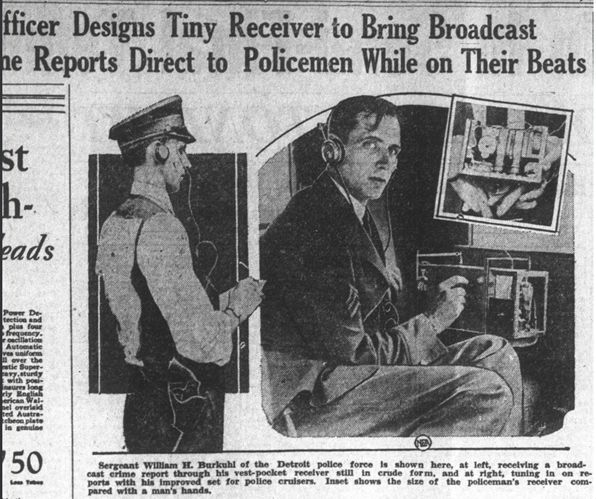
Burkuhl of his own staff was already working on a miniature radio receiver for: police officers. Today (1929) this small receiver, weighing less than four pounds, batteries, earpiece and all, is almost ready for actual use as a means to combat crime with the of radio, At the same time Burkuhl has been experimenting on an improved receiver installation in police cars that cruise about the city constantly in touch with the central radio station of the Detroit police department. Detroit is the first city in the world to operate its own radio broadcasting station in an effort to catch the criminal in his unlawful act. Its success has been so overwhelming that plans are being made to equip every car in the department, not only the police cruisers, with receivers that would keep the entire force on wheels informed of every reported crime almost at the moment of its occurrence.
STARTED AS "HAM" SET BUILDER
Sgt. Burkuhl had been interested in radio ever since it became popular in the early '20's. "I used to bulld radio receivers at my home," he says. "My 13-year old daughter plays the piano and she used to perform on the air at station WBMH, where I first met O. F. Gabbert, one of the owners of this station." "I had been thinking of a little receiver for police officers, and so got Gabbert to help me with his technical training. "Nearly every night, sometimes up to 3 in the morning until our wives chased us to bed, we would wearing on this tiny set. We had it done in five months, Now we are corresponding with some battery makers to provide us with the smallest plate batteries possible, and we are trying to get an earpiece that will fit right into the ear." mallest earpiece that could be obtained, but Burkuhl has designed one that will fit into the policeman's ear so that he won't have to hold that in place. His hands, therefore, would be free to take notes of the broadcast reports. Inset shows Sgt. William H. Burkuhl with his vest-pocket receiver head set for police cruisers. In it are two small tubes, coils, condensers and a transformer so compact that not another inch of wire could be squeezed and it is large enough to fit into the inside vest pocket, while the small batteries for flament can go in the other vest pockets.
AERIAL IN VEST:
Both Mrs. Burkuhl and Mrs. Gabbert helped the men in sewing up 75 feet of wire into a cloth that fits on the back of the vest for an aerial. The little receiver is four inches wide, six inches long and an inch and a quarter deep. Sergeant Burkuhl has been taken off duty to devote all his time for improvement of this individual receiver and of a receiver for the cruisers (NE). Detroit police force is shown here, at left, receiving a broadcast crime. "There are four policemen employed to help him improving beats that surround the district
(het artikel is enigszins ingekort voor de leesbaarheid)